
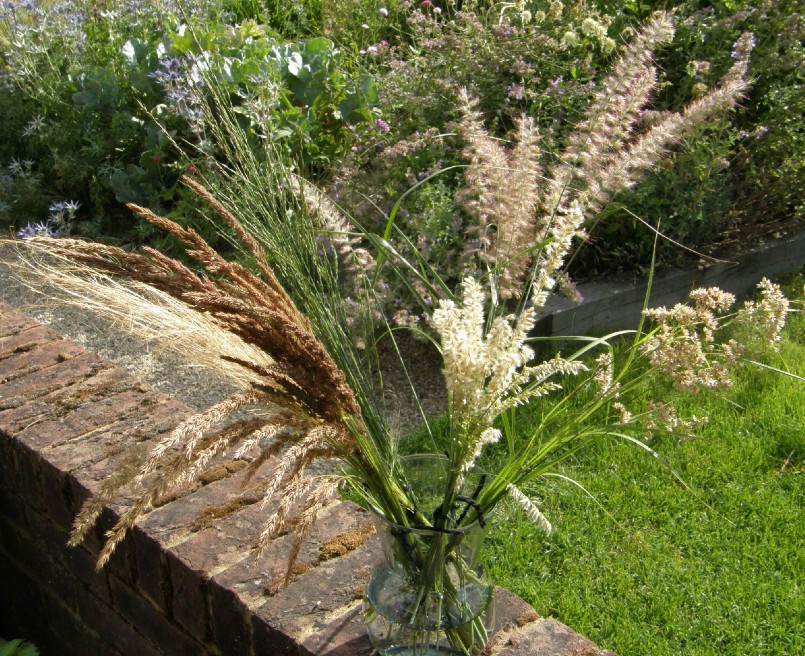
I went round the garden the other day counting how many ornamental grasses I had, either in the garden, or in pots. Those in pots are mostly awaiting new planting places where they might be happier than they were. The answer was 37, rather more than I had imagined. Below is my current top 5 in no particular order.
Calamagrostis x acutiflora ‘Karl Foerster’
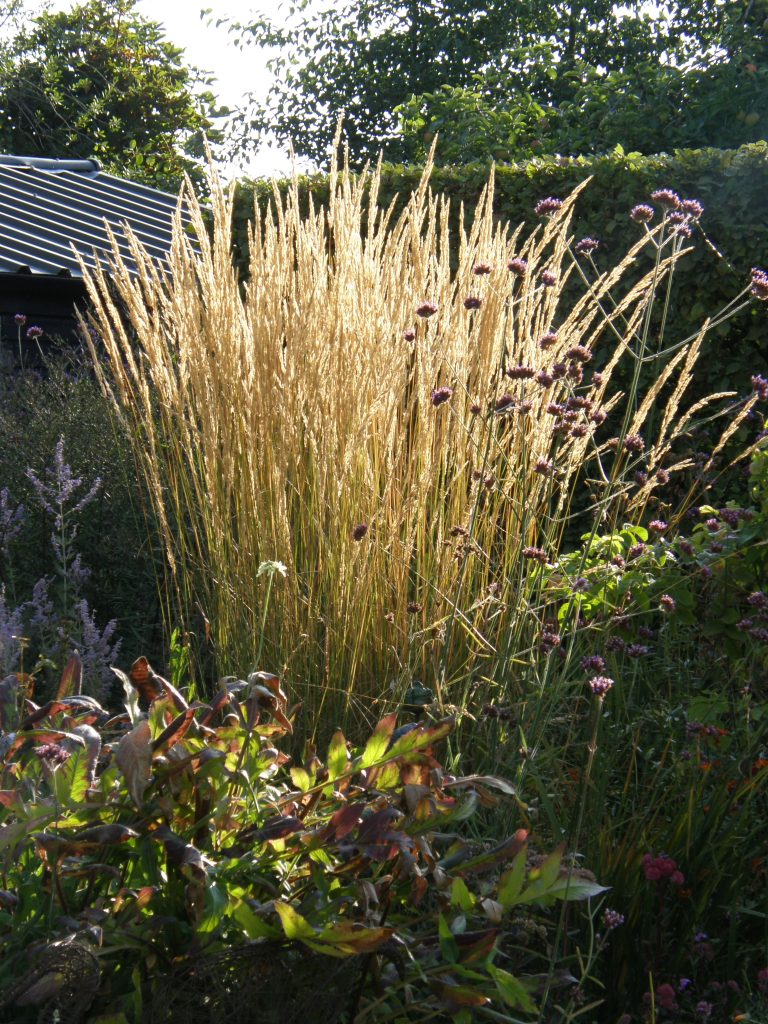
A garden designer favourite with good reason. A cross between two native N European grasses which occurs naturally. Famed German nurseryman Karl Foerster is said to have spotted this particularly good form in Hamburg Botanic Gardens.
This grass has a really long period of interest, the flowers going through three distinct phases from June onwards, (shown here in September), (although it is a little threadbare by late winter).
Lovely wavy movement, a good light-catcher. Shrugs off wind and heavy rain. Deciduous. Early into growth in spring, needs cutting back to the base promptly in early March here in the UK. Prefers sun and some moisture. Height to around 6 feet / 1.8m.
Pennisetum* orientale ‘Shogun’

A pennisetum from warmer parts of the world – native to N Africa, the Middle East and India. This plant is over ten years old and has so far been hardy with me, (some pennisetum cultivars are on the slightly tender side).
The main flowering is June/July, with intermittent new flowers until the autumn. Pink flecks add an extra something to the fluffy flower heads which remain intact for a fairly long period, useful for flower arranging.
A sunny position and reasonably well-drained soil suits it, (mine is in rubbly clay). It seems to remain as a slow-growing clump rather than moving out from a baring middle. Deciduous. Cut back hard in spring. Height to around 4 feet / 1.2m.
*Cenchrus
Panicum virgatum ‘Northwind’
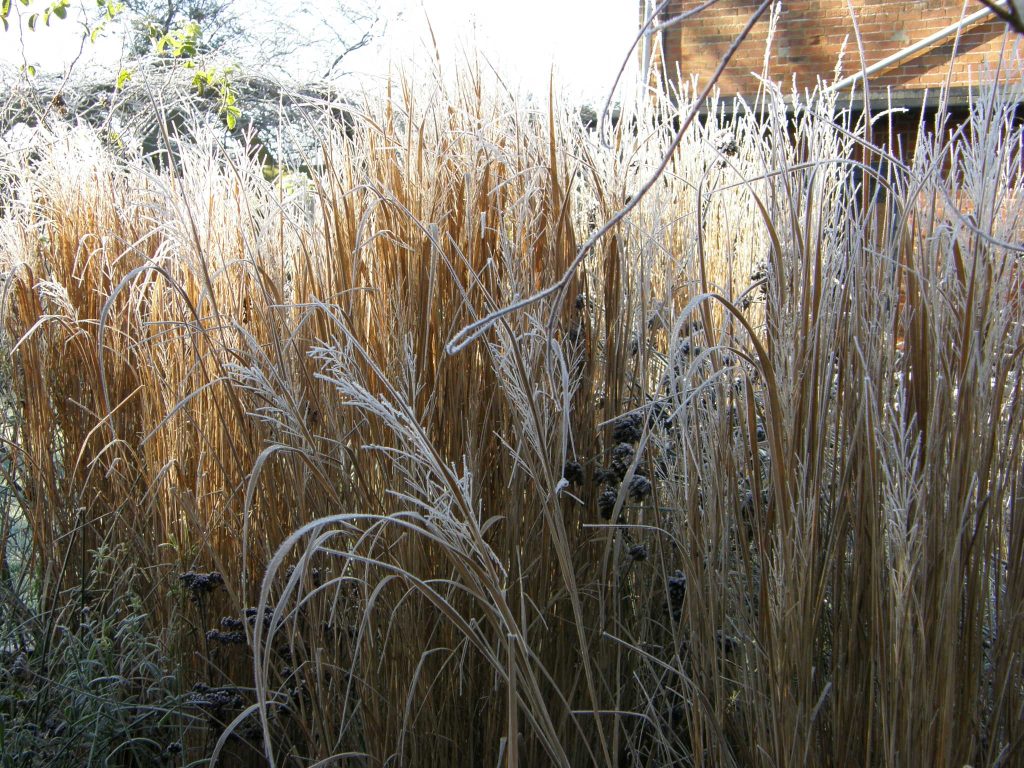
Prairie Switch Grass, an iconic grass of the US prairies, one of the four core species in areas such as the Flint Hills in Kansas. This is a selection made at Roy Diblik’s Northwind nursery in the 1980’s. Rick Darke calls it ‘an absolute workhorse of a grass’.
‘Northwind’ is very upright, the stems and leaves are green, (some panicum have glaucous foliage). I first saw it used as a block planting in the long borders at the Sir Harold Hillier Gardens in Hampshire. We use it as an informal hedge at the back of our grass bed.
Later into growth, the flowers are produced in late summer, and stand well through the winter.
These plants are now 10 years old and are moving slowly out from a now bare centre. I am going to have to lift and divide them in spring to re-invigorate them. Decidous. Cut hard back in spring. Height to 6 feet / 1.8m.
Calamagrostis brachytricha – Diamond Feather Grass
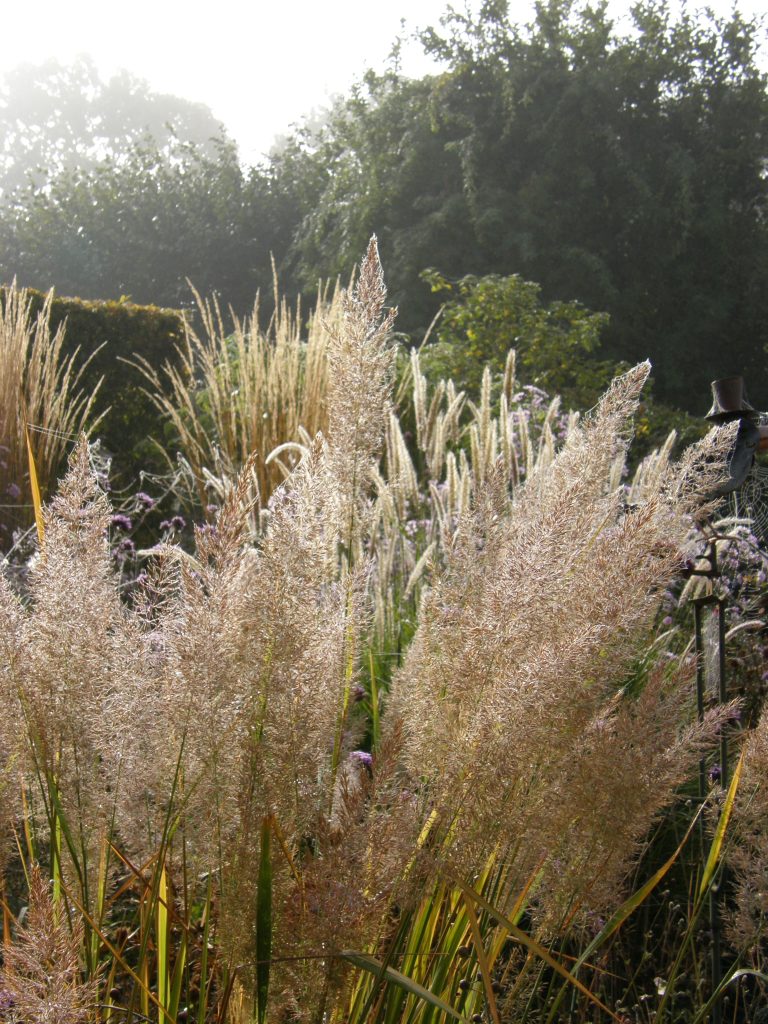
The form we grow was apparently introduced to Longwood Gardens in the US from a plant hunting trip to Korea in 1966.
The flowers are produced in late summer / early autumn. The flowerheads are not as long-lasting through the winter as some. The thick plumes catch moisture in the form of dew and frost, giving it the name, diamond feather grass, rain doesn’t seem to have the same effect.
Deciduous. Fairly early into growth in spring, (another to remember to cut back the old foliage promptly in March). Clump forming. Sun brings out the best plumes. It needs some moisture in the soil to do well, it doesn’t like it too dry. Height in flower to 4 feet / 1.2m.
Molinia caerulea subsp. arundinacea ‘Les Ponts de Cé’
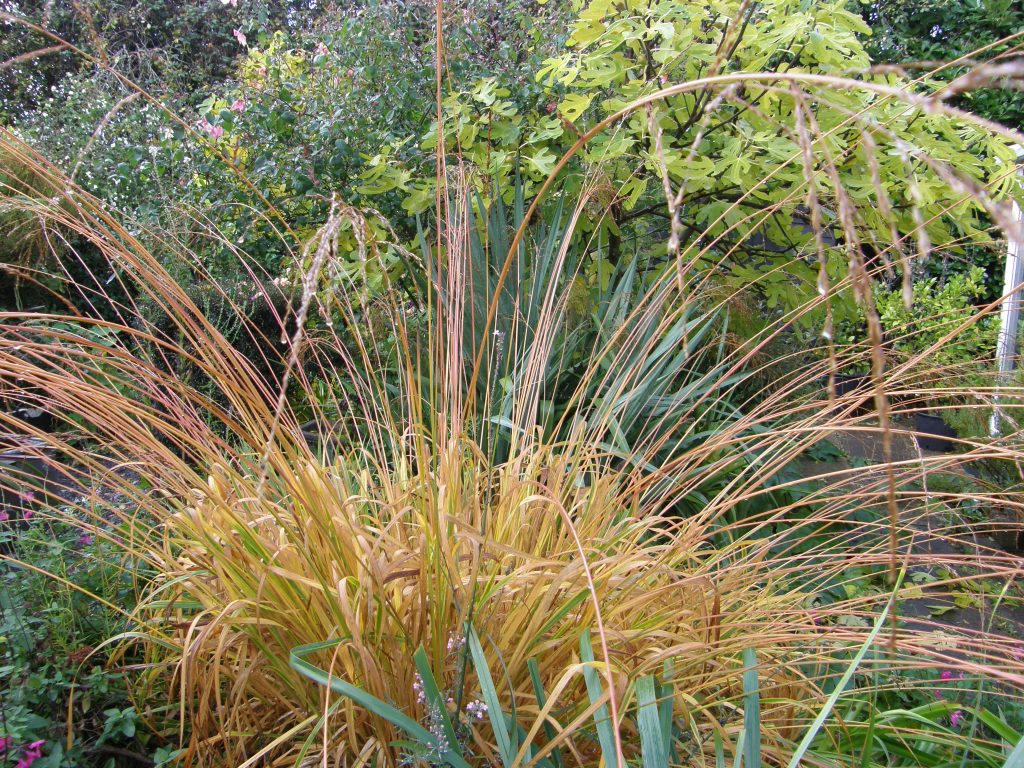
An unusual molinia, as the flower stems arch over rather than grow upright. It needs more space around it than I have given it in this bed to look its best. Sunlit molinia flowering stems work particularly well against a darker background.
Molinia is native to the UK, and most of Europe, preferring some moisture and sun.
Briefly, in the autumn the foliage colours up, (pictured in October), before it all suddenly collapses in a heap. Deciduous. It is easy to clear last year’s foliage by simply pulling it away in spring. Forms a slowly widening clump. Height in flower 4 feet / 1.3m
Question: Can you have too many grasses in a garden?
Answer: Yes, I think you can.
My talk on ornamental grasses takes audiences through the ups and downs, and ins and outs of growing ornamental grasses in my garden, with lots of examples of how garden designers and other gardeners are using them creatively too. Find out more.